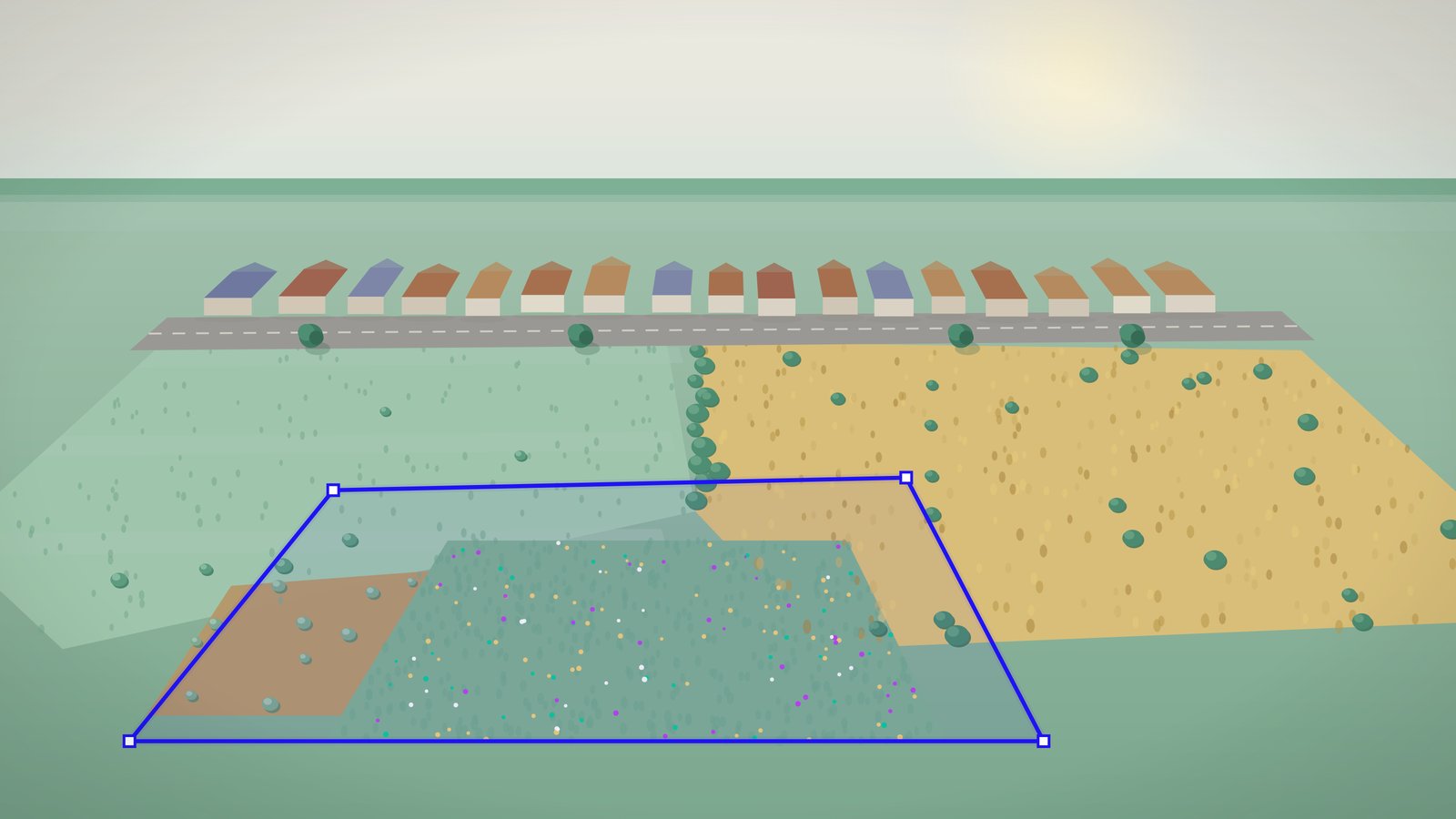
If you develop small sites, you have probably already heard the headline: a new 0.2-hectare exemption is expected to take Biodiversity Net Gain (BNG) off the table for a large share of minor residential schemes before 31 July 2026. Defra's own framing is that it will remove BNG from more than half of the smallest planning applications currently delivering mandatory net gain. (Defra, GOV.UK government response)
That is a genuine relief for a lot of developers. But "under 0.2 hectares" is not the same as "exempt", and getting that distinction wrong is where planning delays start. This post sets out exactly who the exemption covers, the carve-out that quietly pulls sites back into scope, and the one thing you still have to be able to prove.
What's actually changing on 31 July 2026
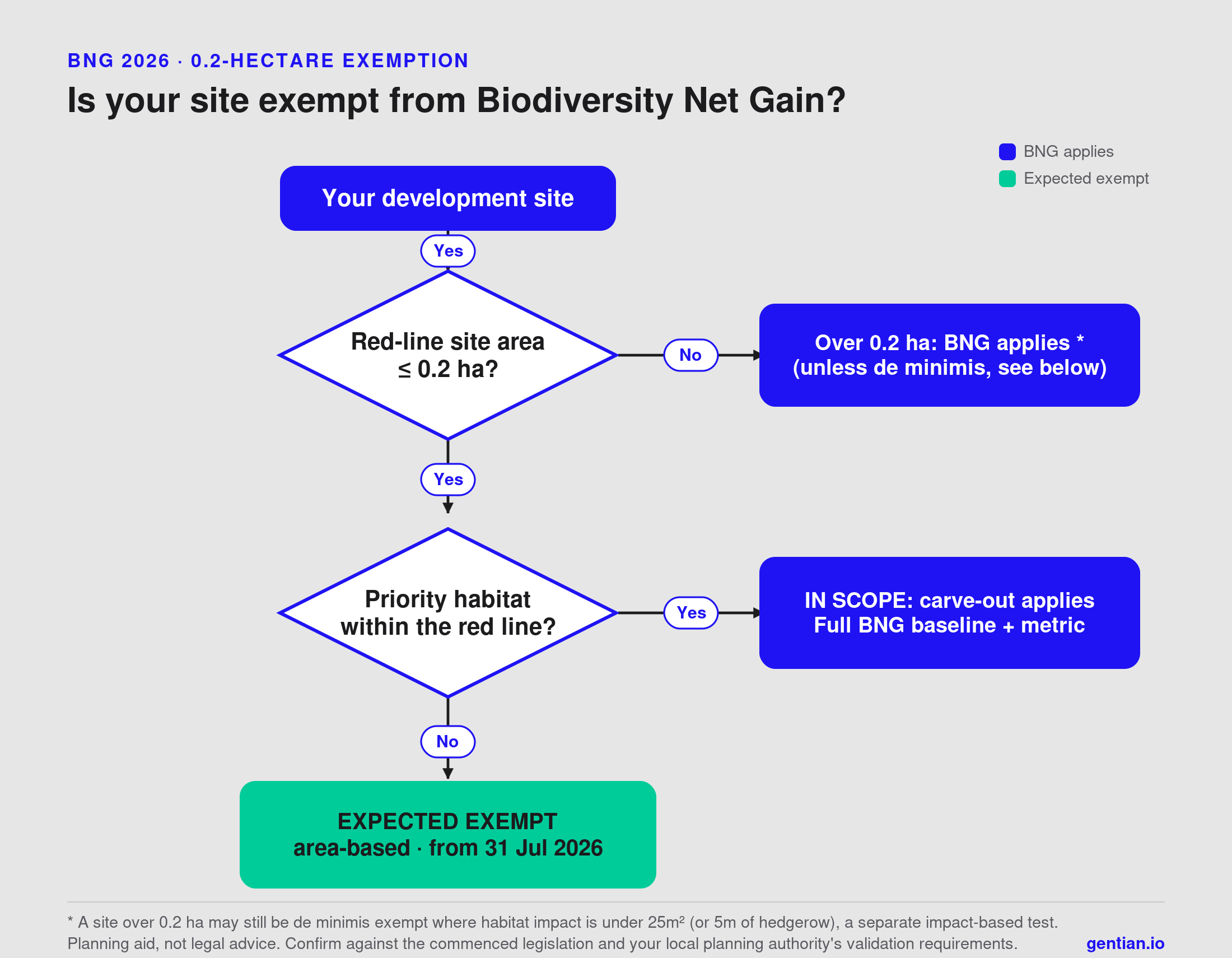
Defra confirmed a package of BNG reforms in April 2026. The headline for small-site developers is a new area-based exemption: where the red-line site area is 0.2 hectares or below, mandatory BNG will not apply, subject to a carve-out for priority habitats (more on that below).
The government intends to bring the secondary legislation forward before the summer 2026 recess, with commencement expected before 31 July 2026, subject to parliamentary scheduling. Treat any scheme where BNG eligibility is finely balanced as still-in-scope until the commencement date is confirmed.
It is not the "de minimis" exemption: and the difference matters
This is the point most summaries blur. The new 0.2ha exemption is area-based (it looks at the size of your site). It is not an expansion of the existing de minimis exemption, which is impact-based: it applies where a development affects less than 25m² (roughly 5m × 5m) of onsite habitat, or 5m of hedgerow. The de minimis rule continues to run alongside the new exemption on its existing thresholds. (LGA, GOV.UK)
Why you should care: a site can be over 0.2 hectares (so the new exemption doesn't help) but still fall under de minimis if its habitat impact is tiny - or vice versa. You need to know which test you're relying on before you write it into a planning statement.
The carve-out that pulls sites back into scope: priority habitats
The 0.2ha exemption is not intended to apply where onsite priority habitats would be affected. (Defra, GOV.UK government response)
Priority habitats (think lowland meadows, deciduous woodland, and other habitats of principal importance under the Environment Act) can sit on plots that look, from the road, like unremarkable scrub or rough grassland. Which means the practical question is no longer just "how big is my site?" It's "is there a priority habitat anywhere within my red line?" If there is, the exemption falls away and you are back to a full BNG assessment.
That is the trap. A developer who assumes exemption on size alone, submits without checking habitat, and then gets a validation query from the LPA has lost weeks - on exactly the small, fast-turnaround schemes where the programme has no slack.
Who is in, who is out: a quick reference
|
Situation |
Likely BNG position (from 31 July 2026, if commenced) |
What you still need |
|---|---|---|
|
Site area ≤ 0.2 ha, no priority habitat onsite |
Expected exempt under the new area-based exemption |
Evidence of site area and confirmation no priority habitat is present |
|
Site area ≤ 0.2 ha, priority habitat present onsite |
In scope (carve-out applies) |
Full BNG baseline + metric |
|
Site area > 0.2 ha, habitat impact < 25m² |
Potentially de minimis exempt (separate test) |
Evidence the impact falls under the de minimis threshold |
|
Self-build / custom build |
Existing self-build exemption is being removed; most self-build plots fall under 0.2 ha and may qualify on that basis instead |
Site-area evidence; full BNG if over 0.2 ha |
|
Residential on brownfield |
Consultation on a brownfield exemption (thresholds up to 2.5 ha) closed 10 June 2026 (no exemption confirmed yet) |
Assume in scope until Defra responds |
This table is a planning aid, not legal advice. Confirm the position for your scheme against the commenced legislation and your LPA's local validation requirements.
The one thing every "exempt" site still has to do: prove it
Here's the shift the exemption creates. BNG doesn't disappear as a question: it moves earlier, to a screening question you have to answer with evidence:
- What is my true site area? (measured to the red line, not estimated)
- Is there any priority habitat within it? (the make-or-break for the carve-out)
Answer both, quickly and defensibly, and you can either claim the exemption with confidence or price BNG into the scheme before it becomes a planning risk. The developers who win here are the ones who can screen a site in days, not weeks, so exemption status is a known quantity at the proposal stage rather than a validation surprise.
How Gentian helps you screen for exemption, fast
This is precisely the gap Gentian's BNG baseline assessment is built for. Working from aerial and satellite imagery, True Sight produces a habitat baseline for a site within minutes without waiting on a field-survey window: so you can see, early, whether a priority habitat sits inside your red line and whether the 0.2ha exemption is genuinely available to you.
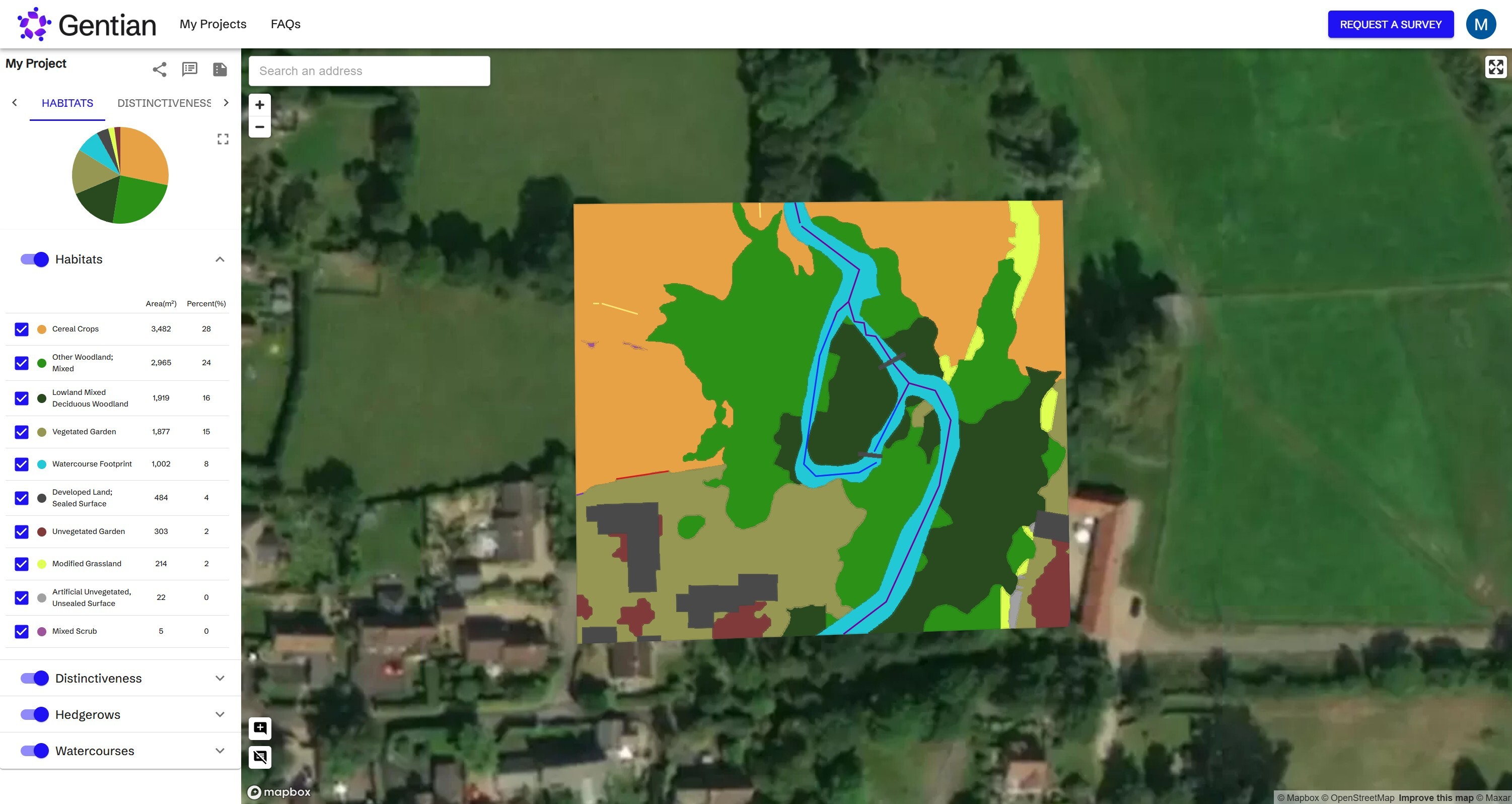
- Screen exemption eligibility and save time at proposal stage: habitat baseline built for a rapid proposal turnaround, so exemption status informs the bid, not the appeal.
- A defensible answer at a lower cost: from as little as £30, outputs are mapped to UKHab and the statutory BNG metric, so the baseline stands up to scrutiny, and you save money compared to traditional surveying methods.
- Can be delivered through your partners: Gentian also works underneath ecology and planning partners, slotting into the workflow you already use rather than replacing your ecologist (contact us to find out more).
See it on one of your own sites. Send us a red-line boundary and we'll show you the habitat baseline Gentian produces - and whether your site clears the 0.2ha exemption.
Login to our platform and order a survey today→
FAQ
When does the 0.2-hectare BNG exemption take effect?
Defra intends to lay the secondary legislation before the summer 2026 recess, with commencement expected before 31 July 2026, subject to parliamentary scheduling. Until it is commenced, existing BNG requirements continue to apply.
Is the 0.2ha exemption the same as the de minimis exemption?
No. The 0.2ha exemption is area-based (site area ≤ 0.2 ha). The de minimis exemption is impact-based (development affecting less than 25m² of onsite habitat, or 5m of hedgerow) and continues on its existing thresholds. A site could qualify under one and not the other.
My site is under 0.2 hectares. Am I automatically exempt from BNG?
Not automatically. The exemption is not intended to apply where onsite priority habitats would be affected. You need to confirm both your site area and the absence of priority habitat within the red line.
Does the exemption remove the self-build BNG exemption?
The existing self-build and custom-build exemption is being removed, but most self-build plots fall under 0.2 hectares and may qualify under the new area-based exemption instead. Plots over 0.2 ha will need to meet standard BNG requirements.
What about brownfield residential sites?
Defra ran a consultation on a possible brownfield exemption (with thresholds discussed up to 2.5 hectares); it closed on 10 June 2026 and no exemption is confirmed yet. Treat brownfield schemes as in scope until the government responds.
.jpeg?width=400&height=250&name=Untitled%20(5).jpeg)